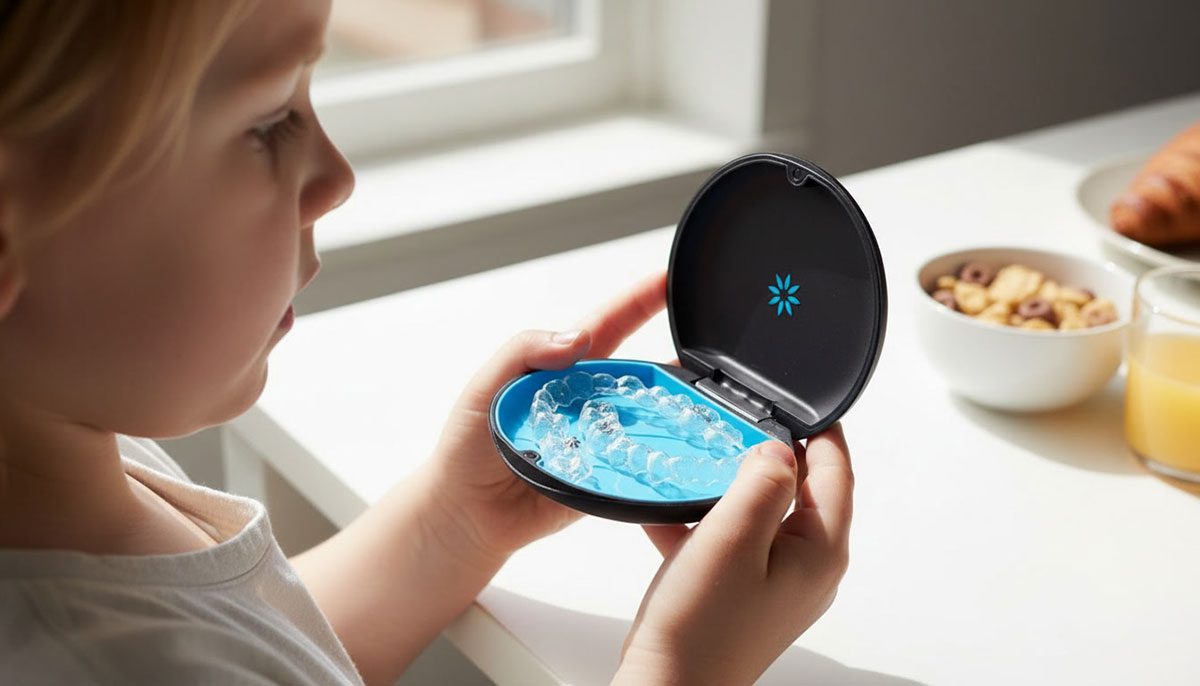
Yes, kids can get Invisalign, including children who still have baby teeth, when daily wear is realistic. We already treat early-phase cases in young kids with Invisalign so they do not need a bulky appliance for that phase, and will not start trays if a child cannot keep them in about 22 hours a day. When the trays will not stay in, braces stay the better call.
What Age Can A Child Start Invisalign?
Most children we evaluate for the first time are around seven, and some of them are ready to begin trays that same year when an early problem is already visible. Not every seven-year-old needs treatment. Some bites need early guidance, some arches need more room to grow, and some children are simply watched while the jaws finish developing. That first orthodontic checkup by age 7 gives a clear baseline to tell the difference. The visit itself is easy on a child, mostly a look and a few photos, and most kids leave asking when they can come back. When an early phase is the right call, Invisalign First is designed for children ages 6 to 10 as that Phase 1 step, and it can address crowding, spacing, and narrow dental arches in a child who still has a mix of baby and permanent teeth. I think about the six-year-old who sits in the chair with two adult lower fronts already in and baby teeth still beside them. The question for her is not whether she is old enough. It is whether a tray right now will guide the arches that are still growing, and whether she will actually wear it. When a parent asks can kids get invisalign, the useful answer starts at this first visit, not with a tray kit.
Does Invisalign Work If My Child Still Has Baby Teeth?
Yes, trays can guide teeth in a mouth that is still half baby and half adult, because the aligners are shaped for that mixed stage. That is what Invisalign for kids is designed around. A child does not need to wait until every baby tooth is gone. The later-stage note on the service page, that a majority of baby teeth have fallen out, describes teenagers finishing treatment, not a rule that younger children cannot begin. What matters at this age is which teeth are in and how the arches are growing. A child with baby teeth beside new adult fronts can still get early orthodontic treatment that makes room and shapes the bite while everything is still moving. Making room for the adult teeth still buried in the gum is quiet work a tray can do while your child eats normally and plays sports without a bracket catching a lip. The trays come out for brushing and flossing, which is part of why they work for families who can keep up with the routine. The honest test is the wear, not the teeth. A tray that rides in a backpack through lunch and goes back in feeling tight at dinner is still doing its job, but only because it went back in.
How Many Hours A Day Does A Child Need To Wear The Trays?
Plan on about 22 hours a day, with the trays out only for meals, drinks, brushing, and flossing. That is the wear the trays are built around, and it is the number to hold to before starting any child. Teeth only move when the plastic is on them, so a child who wears the aligners 14 hours and leaves them on the nightstand the rest of the time will watch the teeth drift back toward where they started. The practical side is the school day. A labeled tray case in a backpack at lunch means the aligners have a home and do not end up in a napkin. The first school day sometimes comes with a small lisp that fades as the tongue adjusts, and parents often say that fades inside a week. A phone alarm for the after-lunch reminder helps until the habit sets, and keeping the previous set as a backup means one lost tray does not cost a week of progress. The part that does not fade is the habit itself, trays in after breakfast, out for lunch, back in, out for dinner, back in for the night. When that rhythm holds, the hours take care of themselves.
When Are Braces Still The Better Call For A Kid?
The call comes down to whether the trays will actually stay in your child’s mouth. When a child will not keep aligners in through the school day and the evening, the fixed option is the one that keeps moving teeth without depending on cooperation. That is the comparison we walk parents through, and it is where braces vs Invisalign for teenagers comes up even for younger patients. The lived version is the child who means well but keeps leaving trays on a lunch tray or tucked in a pocket through soccer practice. A bracket does not care whether your child remembers it exists, which is its main advantage at this age. For that child, waiting is still a plan when wear will not happen, and a bonded bracket simply does the work instead. This is how the three paths sort out.
(1) Trays fit when your child still has baby teeth, the bite needs early help, and wear of about 22 hours a day is realistic for your family.
(2) Braces fit when your child will not keep trays in at school and after dinner, because teeth only move when the plastic is on and a bonded bracket keeps working without that cooperation.
(3) Watching and waiting fits when the age-7 checkup looks stable and no early phase is needed yet, so we let the jaws grow and see you again in a year.
Questions Parents Ask Us
Can a seven-year-old get Invisalign?
Often, yes. Seven is a common age for a first visit, and some seven-year-olds have a bite or arch problem worth addressing early. If the issue is one trays can guide and your child can wear them close to 22 hours a day, treatment can start that year. If everything looks stable, the plan is simply to watch and recheck as the jaws grow.
What if my child loses a tray at school?
It happens, and it is not an emergency. Put the aligners in their case whenever they come out, because a lost tray usually means moving to the next set a little early or stepping back to the previous one for a day. Call the office and we will tell you which. The bigger risk is a tray wrapped in a napkin at lunch, which is how most aligners end up in the trash.
Will my child still need a second phase later?
Maybe, and that is normal. A first phase guides the arches and bite while the jaws are still growing, but it does not finish everything. Once the remaining adult teeth are in, a second phase fine-tunes the alignment. Some children need that second round and some do not. The first phase makes the second one shorter and easier either way, which is the point of starting early.
Are the Phase 1 trays different from the ones teens wear?
The Phase 1 trays are shaped for a growing mouth that still has baby teeth, so they focus on arch development and making room, not on lining up a full set of adult teeth. Teenager trays assume all the permanent teeth are in and work on final alignment. The plastic is similar, but the plan behind it is built for a different stage of growth.
When You Are Ready
When you are ready to talk trays for your child, call (303) 427-5000. We see families across Thornton, Arvada, Brighton, and Broomfield, and you can Meet Dr. Nelson to ask whether an early phase fits your child or whether watching and waiting is the plan for now.